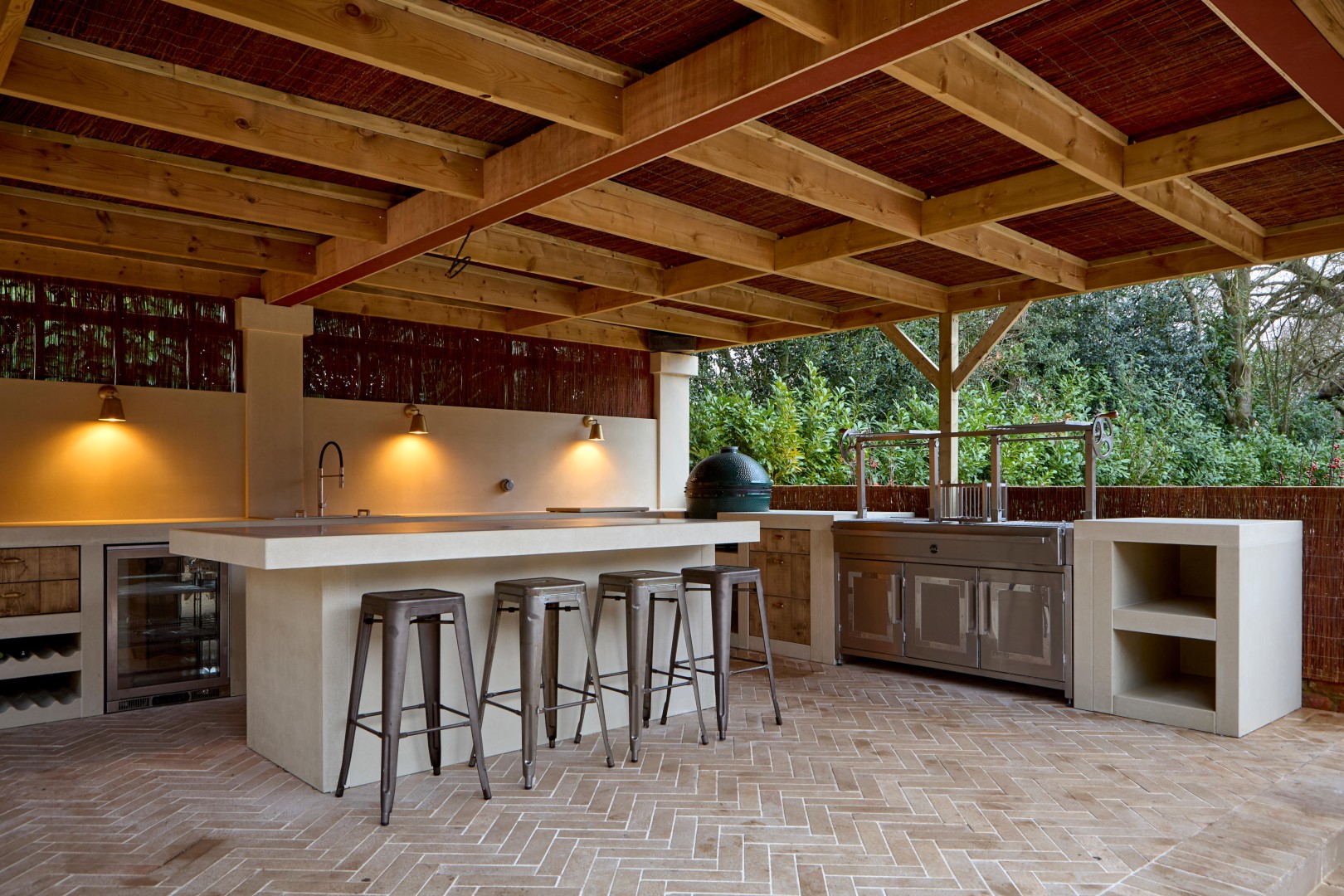
Outdoor kitchens can often sit between desire and doubt. Clients are drawn to the idea of cooking and gathering outside, yet question how often the space will truly be used, particularly in the UK climate. For interior designer Sally McCoy of Edwards McCoy Studio, those concerns are exactly where the design process begins. She approaches outdoor kitchens with the same rigour as interior spaces, considering how they function day to day and how they support the way a client lives. As she puts it, “when a client tells me they want an outdoor kitchen, I already start designing it in my head the same way I would an interior one.”
The positioning of the kitchen within the garden was carefully considered, as it faced a risk of being either unnecessary or impractical. “You don’t want it so close that it feels like part of the kitchen, but you don’t want it so far away that it’s inconvenient,” Sally explains. Instead, the space was designed as an integral part of the home’s living environment, close enough to feel connected but distinct enough to read as its own destination. Outdoors, the opportunity for generous space allows the kitchen to function as a place for people to gather, not just somewhere to prepare food. The materiality plays a quiet but defining role here, with concrete establishing a sense of permanence and architectural intention that anchors the space within the landscape.
Material choice was fundamental to achieving longevity. Many outdoor kitchens rely heavily on timber, but Sally was keen to avoid materials that would struggle over time. “Wood just doesn’t stand the test of time,” she notes. “This is something that should be there for twenty years. It’s part of the building, part of the terrace.” Concrete offered the durability required, responding well to weather while maintaining a calm and grounded presence. Its resilience to moisture, temperature fluctuation and daily wear makes it particularly suited to the unpredictability of the British climate, allowing the kitchen to age gracefully rather than deteriorate. The kitchen has also been subtly sheltered to extend its usability. Covered overhead and partially screened at the sides, it offers protection from rain and drafts without losing its openness. “In this country people often think outdoor kitchens aren’t worth it because of the weather,” she says, “but if you design them properly with the right materials, you can use them far more than you expect.” In this context, concrete becomes not just a structural choice but a strategic one, supporting year-round use through its inherent strength and low maintenance nature.
Designed with a Mediterranean sensibility, the kitchen reflects the clients’ love of Ibiza and southern European outdoor living. This influence is expressed through proportion, lightness of tone and tactile detail rather than overt styling. A bespoke Italian mosaic set into the island introduces craft and softness, balancing the strength of the concrete. The versatility of concrete allows it to shift between robust and refined, acting as both backdrop and focal point depending on light, texture and surrounding materials. “There aren’t many outdoor kitchens that are designed to be both practical and beautiful,” Sally reflects, “but there’s no reason they shouldn’t be.” As the vines grow over the structure and the garden matures, the space will begin to feel less like a feature and more like an outdoor room. “You’ll feel like you’re stepping into another room,” she adds, “not just going outside.” Over time, the concrete will develop a subtle patina, reinforcing the sense that this is a permanent, considered extension of the home rather than a temporary installation.
At its core, the project reflects a belief that outdoor kitchens are not seasonal luxuries but genuine extensions of the home. When designed with care, they allow daily life to move outdoors, encouraging shared moments and slower meals. Rather than an add on, the kitchen becomes another room, defined not by walls, but by how it is lived in. Concrete underpins that permanence, by being a material capable of combining structural integrity, refined aesthetics and enduring performance in one cohesive architectural gesture.
Acknowledgement:
Designer | Sally Anne McCoy of Edwards McCoy Luxury Interiors, London
